The tanks on Flamenco Beach, and the date most guides get wrong
1975 for Culebra. 2003 belongs to Vieques.
At least one otherwise decent Culebra guide tells its readers the tanks were left when the Navy ended bombing exercises in 2003. That is the Vieques withdrawal, twenty-eight years later and a different island. Culebra’s date is 1975.
I am labouring this because it is checkable, because it is the kind of error that gets copied from site to site until it becomes what everybody knows, and because it is a fair test of whether the rest of a page is worth your time. The correct pairing is Culebra 1975, Vieques 2003. If you read 2003 attached to Culebra anywhere, including here, it is wrong.
The years in between are the story. The range opened in 1939 and ran for more than three decades. Residents protested from 1970 to 1974, on an island whose whole population today is about 1,792 people, and the Navy left the year after. The tanks are what got left behind when its attention moved one island west.
What I will not tell you about them
Not the model. Not the unit. Not the year they were put there. Sources disagree between one designation and another, and between “two” and “several”, and I have no way to settle it from here. Two abandoned tanks is the limit of what I can support, so it is the limit of what I write.
Why there is no photograph of a tank on this page
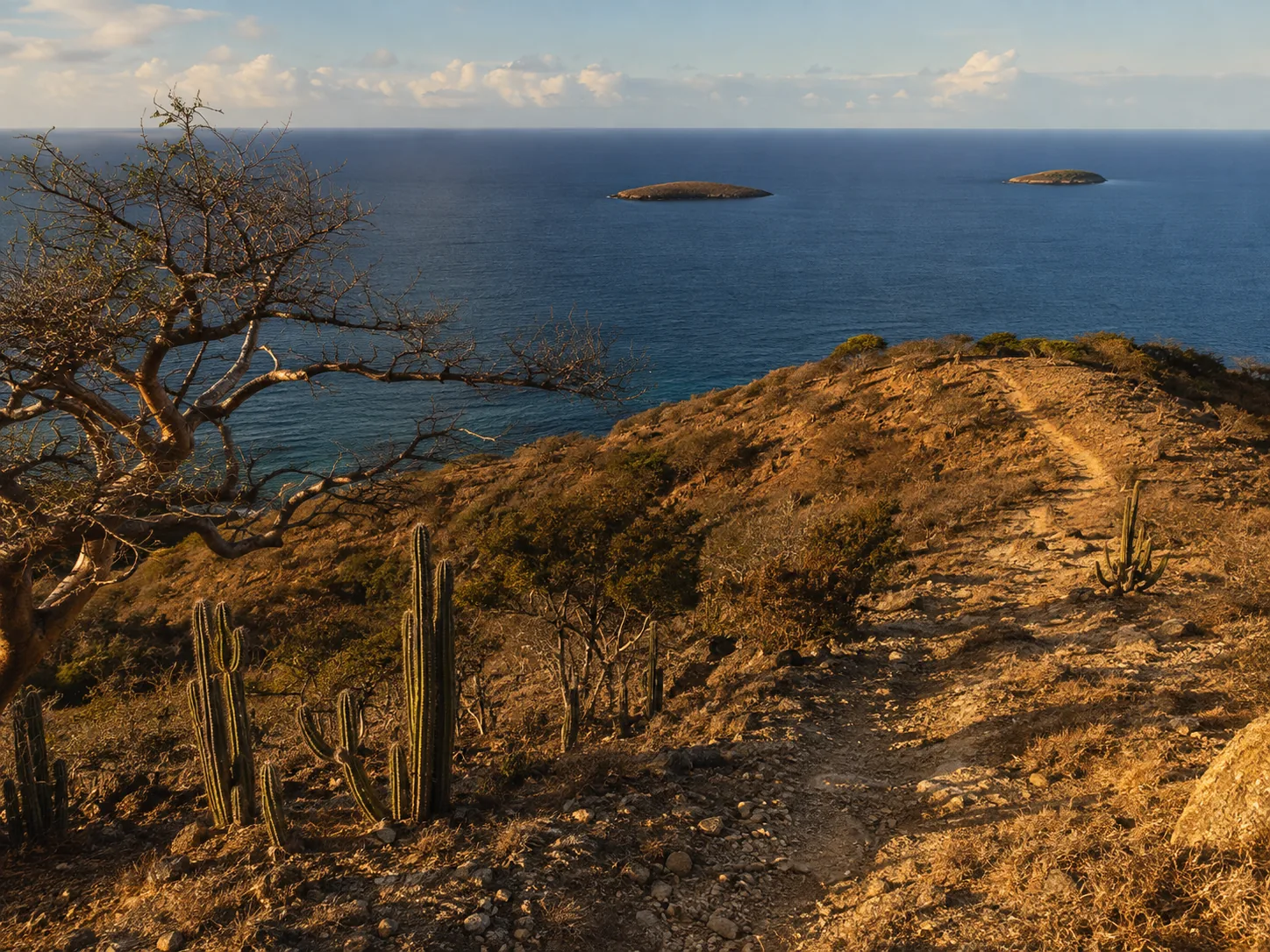
Every image on this site is generated, and the site says so. That is fine for a hillside or a queue at a terminal, which are types of thing. The tanks are not a type of thing: they are two specific objects, individually photographed by thousands of people, wearing paint that changes from month to month. A generated tank on the page about the tanks would be an invention of a real object dressed up as a record of it. So they are written about here, from sources, and never drawn.
Seeing them, and what else the beach carries from that period
They are on the sand, in the open, at the western part of a bay that runs about one mile around. You do not need directions and you do not need a guide; you need the couple of dollars for the wristband that everybody pays at the entrance and a walk along the beach. People photograph them, sit against them and leave. They and the water are what the beach is known for — why Flamenco is famous takes both apart, including the 2013 ranking that gets quoted without its year.
The archipelago the range covered is also where the Culebra National Wildlife Refuge sits today: about 1,510 acres and 21 offshore cays of dry forest and mangrove. What lives there. And the comparison people reach for after reading this, Culebra or Vieques, is a difference rather than a ranking: two islands with different histories, different sizes and different logistics.
If you are working out the trip itself rather than the history, start with the first-visit guide.
Frequently asked questions
Why are there tanks on Flamenco Beach?
They were left by the US Navy, which used the Culebra archipelago as a gunnery and bombing range from 1939. Residents protested between 1970 and 1974, and in 1975 the Navy stopped using Culebra and moved those operations to Vieques. Two tanks were never removed, and they have been repainted with graffiti ever since. One sits nearer the west end of the bay, the other closer to the water.
When did the US Navy stop bombing Culebra?
1975. The often-quoted date of 2003 is the end of Navy exercises on Vieques, twenty-eight years later and a different island, and at least one popular Culebra guide prints it as though it were Culebra’s. The correct pairing is Culebra 1975, Vieques 2003 — and that difference is also part of how the two islands differ.
How many tanks are on Flamenco Beach?
Two. You will find sources naming a specific model, a unit and a year they were placed, and they do not agree with one another, so this site does not repeat any of it. Two abandoned tanks, continually repainted, is what can be supported. Reaching them costs the same wristband as the rest of the beach — see the entrance fee.